Cable Shoulder Workouts are often ignored but can be just the ingredient that makes your routine complete. Dumbbells appear to be the established choice for shoulder day do you think that is really the best option to consider? The shoulder dumbbell press gets most of the glory and attention. Yet many do not include cable-based exercises for the shoulders. So now could be an ideal time to look into this for the building of strong and healthy shoulders.
Another one is joint safety. If you’ve ever had limited range of motion or continuous strain through overhead dumbbell presses, then cables are probably your shoulder-saving best friend. The smooth resistance that can be adjusted will help you to avoid those jarring movements that are hard on the joints, especially when pressing.
Ready for some fresh shoulder challenges? See how cable shoulder exercises can revolutionize your workout with exercises tailored for you. Step beyond dumbbells and take a serious look at Workouts for men that include cables for results unlike any other.
Why Cable Shoulder Workouts Trigger Better Muscle Growth
Have you ever thought about why cable shoulder exercises are often suggested by professional trainers for building well-defined shoulders? The reason is how cables provide continuous tension, stability like no other, and precise angles to enhance muscle activation and growth. Let’s further discuss why cables might just be the game-changer in your shoulder routine.
Constant Tension: The Secret to Hypertrophy
One of the very powerful things about shoulder cable exercises is that they will provide constant tension for the entire length of motion. Dumbbells use gravity and cease being tense at certain intervals during the lift; however, the cables maintain an even load distribution throughout the movement.
Why does that matter? Why is constant tension important? Consistent tension keeps the deltoids under strain throughout the entire range of motion, and this constant strain forms the best possible environment for hypertrophy (muscle growth).
Stability and Controlled Movement
Have you ever encountered a dumbbell somehow wobbling from side to side, or have you ever felt strain in your shoulder joints while working out with free weights? The cables are designed to address such issues. The cable shoulder exercises allow the pulley system to control the movement, ensuring the best control and stability. Because the movement is controlled, it prevents any unnecessary strain and serves well.
Better Angles, Better Activation
Cables take everything else into consideration when it comes to shoulder exercises. Various settings allow you to work the different heads of the deltoids much better than dumbbells or machines can. Want to work on your rear delts? Just reposition the pulley either by height or angle and you are good to go, respectively for activation.
The lateral raise is just another example of how the adjustable angles of a cable system provide better movement than dumbbells, which can actually cause awkward strain during certain parts of the range of motion. Cables really do work to create an ideal angle for every rep so that you can get more out of building your shoulders.
Downsides of Dumbbells for Shoulder Training
One major issue with dumbbells is the limitation of their movable paths during a dumbbell shoulder press, gravity and wrist position primarily govern the path of the movement, generally preventing that deep stretch or best contraction. This is where cables excel.

Think about them as the distinctions between how cables work better than dumbbells for shoulder training:
- Consistent tension: Cables offer intrinsic resistance to the muscles throughout the motion, while with dumbbells the force exerted changes throughout the action depending on gravity forces.
- Joint movement: Angles can be manipulated to place less stress on the shoulders, therefore preserving them from possible injury.
- More precise targeting: Let them concentrate on a specific deltoid without going into excessive stabilizers.
- Form enforcement: With cables, your hands are never going to be tempted to swing out of sync, so better biomechanics can be nurtured.
So for those after strong and defined shoulders, the cables present an effective and friendly joint option. And if you’re looking to complement your routine with something new,you might want to explore Wall Pilates Workouts for low-impact strength training. Your shoulders will thank you.
Comparing Cable Shoulder Workouts to Dumbbell Exercises
Still wondering whether cable workouts outperform dumbbells? Check out this quick comparison to help you decide.
| Feature | Cable Shoulder Workouts | Dumbbell Shoulder Workouts |
|---|---|---|
| Muscle Engagement | Consistent tension throughout the range of motion | Varied tension depending on the angle |
| Stability Requirement | Low cables assist with directional stability | High engages stabilizer muscles |
| Joint Friendliness | Excellent smoother movement reduces strain | Moderate requires careful form to protect joints |
| Setup Convenience | Quick adjustments via pulley system | Manually position weights; requires space |
Try This Ultimate Cable Shoulder Workouts Plan
Shoulder workouts with cables are a godsend if one intends to build stronger, more defined shoulders without the balancing issues of free weights. Whether it be for symmetry, hitting particular deltoid heads, or just avoiding joint pain, cables are the most versatile equipment and offer constant tension, which dumbbells sometimes fail at. So, here is a programme that hits all three parts of the deltoid front, side, and rear, optimally using the cables.
Why Choose Cable Shoulder Workouts?
- Constant Tension: While with dumbbells the muscle activation diminishes at some point in the range of motion, with cables the muscles stay engaged throughout.
- Joint-Friendly Movements: Since the cable transitions tend to be some degree smoother, this characteristic can become very important when it comes to anyone with mobility issues or recovering from an injury.
- Versatility: Adjustable angles and pulley systems provided by the cable system open up all avenues to hit every single angle and fiber of the shoulders with ease.
Ultimate Cable Shoulder Workouts Routine
This 4-exercise routine has a mixture of strength and toning activities to work out every one of the three deltoid heads. Performing every exercise for 3–4 sets of 12–15 reps can produce a real burn feeling, and results will show afterward.
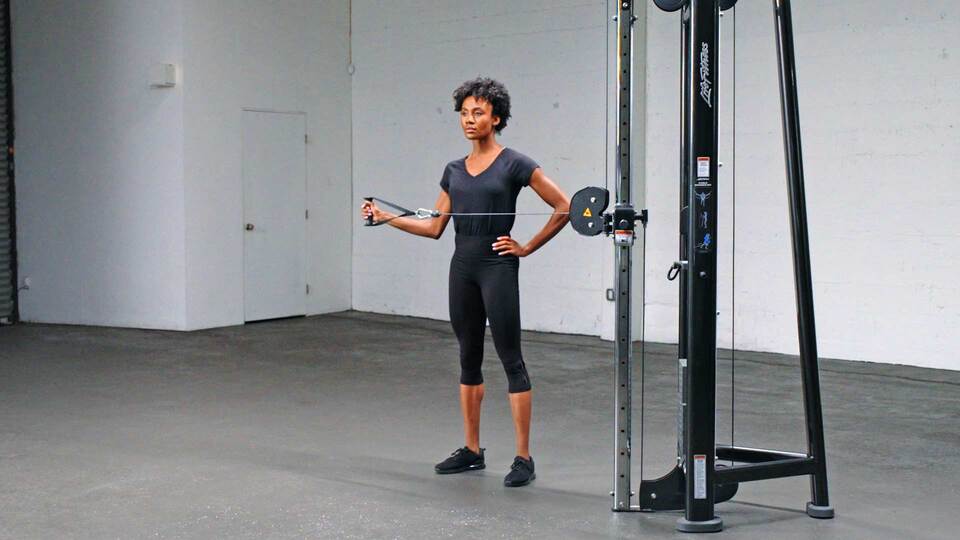
1.Cable Lateral Raises: For the lateral delts, the cable lateral raise is a perfect choice. Keep the pulley at the lowest possible setting, grab the handle with one hand, and raise your arm laterally to shoulder level. This will allow for absolute isolation and definition for your shoulders.
2.Reverse Cable Flyes: Pour out to your rear delts. Set cables at shoulder height, cross your arms to grab opposite side handles, and pull them back in a controlled fashion. A great way to straighten out your slump!
3.Cable Front Raise: Works on anterior (front) deltoid. With the pulley set at the bottom, grab the handle with one hand and bring it up straight till shoulder level. Good for strength balance in the upper body.
4.Cable Shoulder Presses: The working compound move that works via cable for accuracy. Set the pulley to shoulder height, grasp both handles, and press upward; this one should be your choice when building on overhead strength while maintaining shoulder joint integrity.
Time to step up your shoulder game. With cable shoulder workouts, muscle building evolves into a precise and mindful shoulder-strengthening discipline. Try this program and also feel the results yourself. Your shoulders will thank you!